CREST-AI: Countering Epistemic, Semantic and Technological Asymmetry in AI-Human Collaboration Focusing on Expert-Layperson Simplification
Our highly differentiated, complex modern society is characterized by crisscrossing gradients in expertise and knowledge. When we consult with our physician about different ways to lower our blood pressure, when talking with a carpenter about the best way to fix our leaking roof, or when taking counsel with a lawyer on how best to resolve an escalating conflict with our health insurance, we always have to accept that there is an asymmetry in knowledge and understanding between us, who should take a decision, and the person that’s counseling us on the matter at hand using her expertise in the topic. The asymmetry is epistemic – we laypersons do not know how to weigh or judge any evidence in favor of or against an expert claim – and semantic – sometimes we simply do not understand the relevant concepts or theories. While, arguably, some epistemic and semantic asymmetry is ineliminable from complex modern societies with various specialized sub-fields, this asymmetry becomes particularly problematic if it excludes entire groups of people from making use of their rights.
The advent of generative and conversational Language AI powered by Large Language Models (LLMs) has been a blessing and a curse at the same time regarding these epistemic and semantic asymmetries. On the one hand, they can be genuinely helpful in explaining concepts and elucidating theories. On the other hand, they create new technological asymmetries and opacities: Firstly, there is the black-box, implicit nature of neural methods. We know that they perform well, but we do not know why, which also means that we do not know when they might fail catastrophically. Secondly, the frontier models are proprietary technology, controlled by a handful of people globally, and we often do not even know the basic configuration of them, their training data, or resource consumptions. As a consequence, creating transparency in the epistemic and semantic realm by simply relying on off-the-shelf proprietary LLMs solves two challenges to our rational autonomy by creating at least as many others.
The core vision of CREST-AI is to aim for transparency in the epistemic, semantic, and technological dimension all at once and hence to contribute towards reinstituting human autonomy in an age of AI. The goal is to push progress in theory and applications to build an ecosystem of multidimensional transparency to level the epistemic playing field in legal matters and hence to make some progress towards a more equitable and fairer society.
Our overall approach fuses state-of-the-art accessibility and explainability methods in NLP with cutting-edge research in philosophy of AI and language. In philosophy of AI, we adopt a loosely Kantian view according to which this threefold asymmetry threatens humans’ rational autonomy. In philosophy of language, we adopt an inferentialist conception of semantic and epistemology. Inferentialists put inferential relations between propositions center stage for both meaning constitution and reason relations: A proposition gets its meaning by its location in an implication space (IS). To know what a concept means is to know its conceptual role in propositions, to be able to provide reasons for one’s claims is to be able to cite propositions that entail these claims. An expert’s IS is going to be structurally richer than a layperson’s IS on the same topic.
To illustrate our overall approach, imagine that you are a Swiss citizen about to fill in your tax returns. After a good trading year, you are unsure how to declare the capital gains from your trades, which is a notoriously difficult topic in Swiss tax law, centering around the correct interpretation of Art. 16 DBG. Now, imagine you are feeding Art. 16, including the crucial paragraph 3 into an automatic text simplification (ATS) system, see Figure 1 for an illustration. Regarding §3, this seems a rather accurate simplification, simply replacing the concept «capital gains» by «profit».
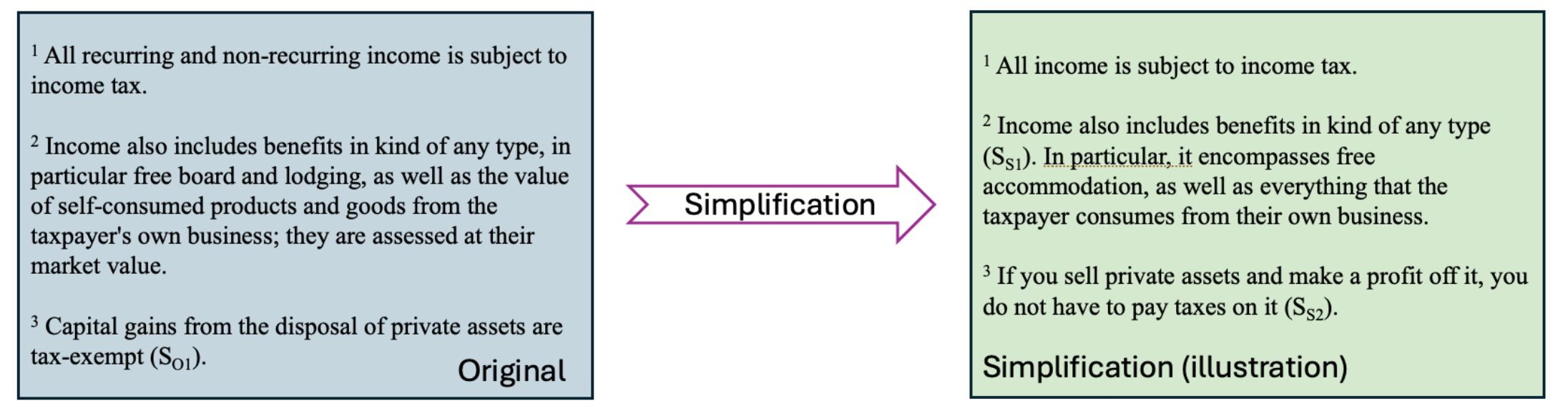
Figure 1: Illustrative Simplification of Art. 16 of the Swiss Law for Federal Taxation (DBG). SOi refers to a numbered sentence in the original, SSi to a numbered sentence in the simplification.
However, in the expert debate, much hinges on something’s being a capital gain. For instance, it is established by supreme court decision that buying and selling shares very frequently entails that the capital gains realized by it likely count as taxable income. So for capital gains to be tax-exempt requires that you are not trading in stocks very often (call this SE1). Furthermore, it is also established that if I sell the stocks to a company that I control, then this entails that the gains realized are not capital gains (call this SE2). Furthermore, assume that I do not understand what «benefits in kind are». On the inferentialist view adopted in this project, one can sketch this situation as in Figure 2: As a layperson, I have a grasp of what SS2 entails and is entailed by (hence the arrows leading to and from this node to the layperson’s knowledge graph), I also understand that it entails SE1, but SE2 is beyond the scope of the simplification, and I cannot embed SS1 in my IS – which means I am not understanding that part of the simplification.
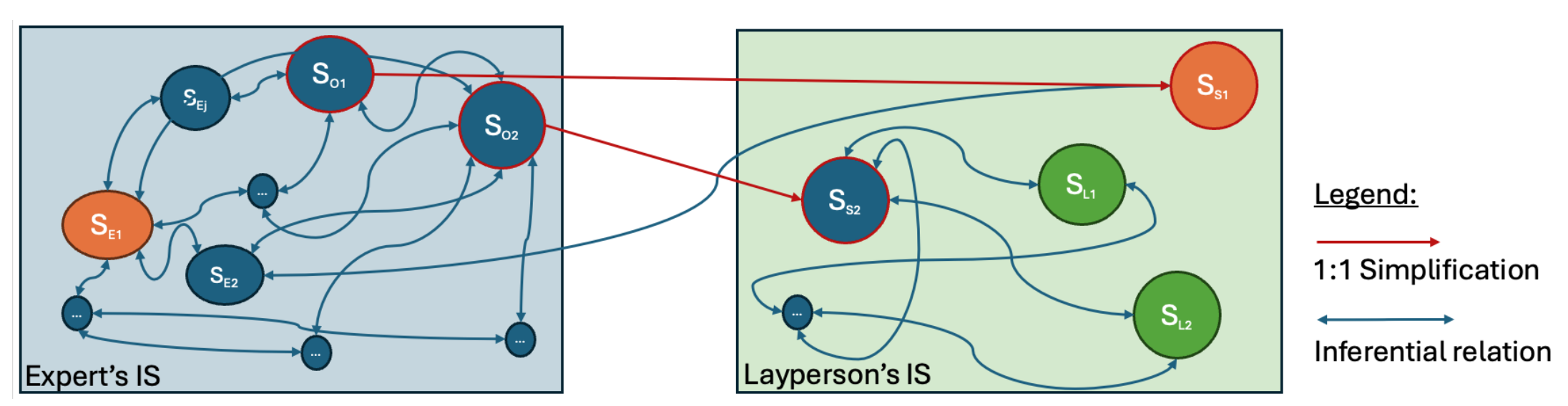
Figure 2: Schematic Visualization of how we conceive Human Understanding and Meaning Preservation from an inferentialist perspective in a context of Automatic Text Simplification (ATS).
Within this setting, we have identified the following core challenges, which we propose to address using the following core ideas.
- Core Challenge 1: Epistemic Asymmetry. From a Kantian perspective, the asymmetry in knowledge and understanding existing between expert and layperson, but which is more generally characteristic of the human condition in an age of AI, threatens human rational autonomy: To be rationally autonomous requires understanding the situation and drawing the conclusions that are most warranted by the available evidence.
- Core Challenge 2: Lack of Suitable Accuracy and Simplicity Metrics. The field of ATS currently lacks semantically sound metrics to assess the accuracy (i.e., meaning preservation) and the extent of simplification achieved by ATS methods in expert-layperson settings.
- Core Challenge 3: Lack of Technological Transparency of Current LLM-Based Language AI. Current LLM-Based Language AI Systems, including ATS Systems, typically function as black-box tools that provide simplified outputs without explaining the underlying transformations. This lack of transparency not only limits user control but also raises ethical and regulatory concerns – particularly in light of the recently established EU AI Act.
Research supervised by Dr. Reto Gubelmann will address Core Callenges 1 and Core Callenges 2 from an interdisciplinary perspective, combining Neo-Kantian and Inferentialist Philosophy with State-of-the-Art methods in Natural Language Inference. This research will be closely coordinated with the research streams of the project partners, Prof. Dr. Christina Niklaus (HSG, overall PI) and Prof. Dr. Peter Hongler (HSG).